What Adaptive Questioning Does to Demographic Measurement: Evidence from Verbal Autopsy Surveys
Working paper · presented at the 2026 FDS Workshop on AI for Social Science Research Methods, Yale University
2026 working paper
This portfolio is organized by scientific problem rather than chronology. The three core sections mirror my research program, showing how individual studies contribute to better measurement, stronger health-information systems, and demographic inference under incomplete data.
Recent and ongoing work appears alongside established evidence within each theme. Paper titles and figures link directly to the DOI or publication page; publication status is shown inline. Yue Chu is shown in bold, with first, joint-first, and corresponding authorship identified where applicable. Google Scholar · Full academic CV
How respondents, interviewers, instruments, and collection settings generate omission, displacement, misclassification, and other bias in population-health data.
Working paper · presented at the 2026 FDS Workshop on AI for Social Science Research Methods, Yale University
Poster presented at the 2026 Annual Meeting of the Population Association of America.
Journal of Global Health. 2023;13:04086.
Demography. 2020;57(5):1705–1726.
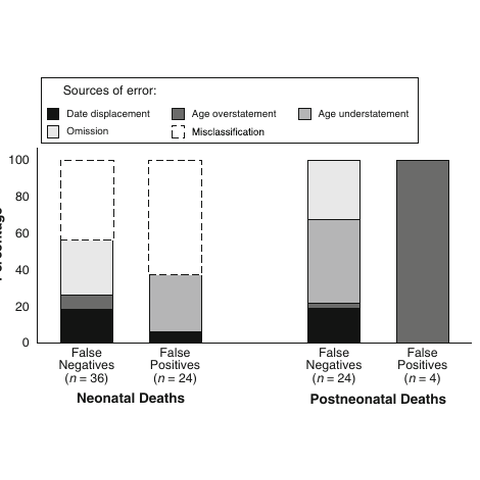
PLOS ONE. 2016;11(12):e0168743.
Designing, validating, monitoring, and integrating cause-of-death measurement tools across research, surveillance, and civil-registration environments.
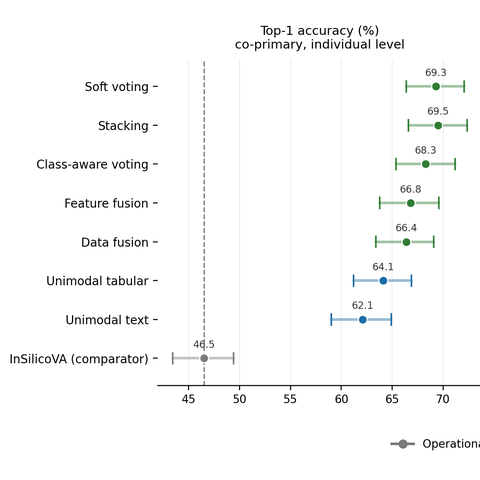
medRxiv. 2026.
Software paper in preparation · package publicly released and MIT-licensed
Working paper
Global Health Action. 2021;14(sup1):1982486.
Estimating fertility, mortality, and cause-of-death patterns from incomplete histories and heterogeneous survey, surveillance, registration, and modeled evidence.
Manuscript in preparation · presented at PAA 2021
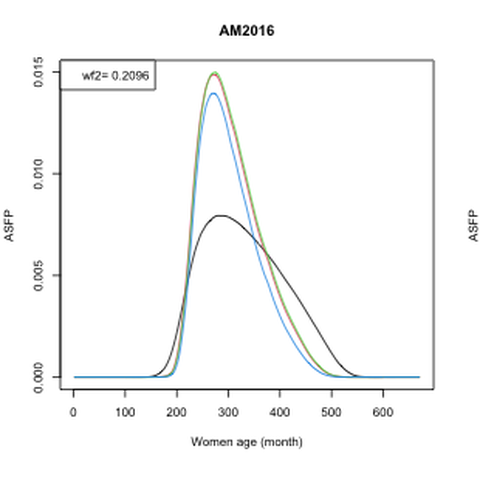
Under review
Lancet Global Health. 2024;12(8):e1278–e1287.
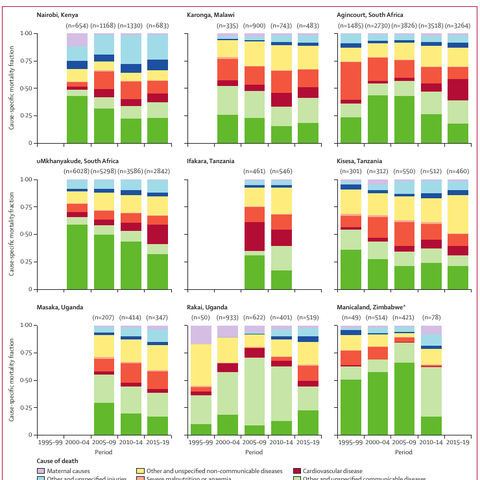
Journal of Global Health. 2022;12:11008.
The Annals of Applied Statistics. 2022;16(1):124–143.
Population Health Metrics. 2022;20(1):3.
Lancet Global Health. 2019;7(6):e721–e734.
Lancet Child and Adolescent Health. 2020;4(9):678–687.
Lancet Global Health. 2019;7(1):e47–e57.
Lancet Global Health. 2019;7(6):e735–e747.
Journal of Global Health. 2019;9(2):020804.
Journal of Global Health. 2019;9(2):020801.
Lancet Global Health. 2018;6(7):e744–e757.
Lancet. 2018;391(10129):1538–1548. Group authorship; contributed as a Research Associate at Johns Hopkins Bloomberg School of Public Health.
Lancet Global Health. 2017;5(2):e186–e197.
Lancet. 2016;388(10063):3027–3035.
Journal of Global Health. 2016;6(2):020802.
In Reproductive, Maternal, Newborn, and Child Health: Disease Control Priorities, Third Edition (Volume 2). World Bank; 2016. Chapter 4.
Amsterdam: KIT Royal Tropical Institute; 2018. Role: consultant demographer; conducted the mortality and cause-of-death analysis and drafted the corresponding report sections.
Selected collaborations applying epidemiologic, Bayesian, and evidence-synthesis methods beyond the three core research lines.
Annals of Epidemiology. 2022;67:50–60.
Proceedings of the National Academy of Sciences of the United States of America. 2021;118(26):e2023947118.
Annals of Internal Medicine. 2017;166(9):649–658.
Annals of Internal Medicine. 2016;164(11):740–751.
AHRQ Comparative Effectiveness Review Report No. 16-EHC013-EF. Agency for Healthcare Research and Quality; 2015.